How We Build Your Die
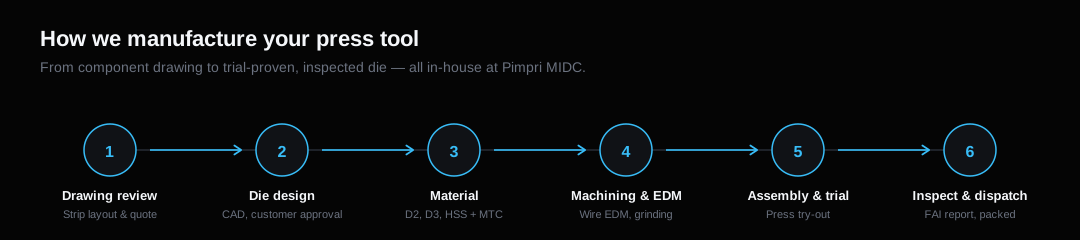
Drawing approval to inspected, trial-proven die.
Engineering heavy-duty forming dies, deep drawing tools, and large-bed progressive dies for the expanding industrial and automotive plants in Talegaon MIDC.
Every die designed on CAD, cut on Wire EDM, and proven on the press before it leaves Pimpri.
A sheet metal die is the tooling that shears, punches or forms a flat metal strip into a finished component. At Precision Industries, we manufacture robust sheet metal dies capable of handling thick materials and deep drawing operations, perfectly suited for the large-scale manufacturing units in Talegaon MIDC.
Dies are cut from D2, D3, H11 and M2 HSS tool steels, hardened to HRC 58–62, with punch and die profiles finished on our Electronica, Sodick and Mitsubishi wire EDM machines to ±0.005 mm. We handle sheet from 0.3 mm foil-gauge up to 6 mm plate, in mild steel, stainless, CRCA, GI, aluminium, brass and copper.
Because design, machining, hardening coordination, assembly and press try-out all happen under one roof in Pimpri MIDC, lead times stay short and quality stays accountable. Every die ships with a First Article Inspection report.
Materials, tolerances and sizes we work to.
From single-operation tools to complex progressive dies.
Shear a flat blank from strip stock with clean, burr-controlled edges. Sized for your press tonnage and material.
For: washers, flanges, flat brackets, base plates
Punch precise holes, slots and cut-outs with accurate hole-to-edge positioning and long punch life.
For: perforated panels, terminals, vented parts
Blank and pierce in a single stroke where hole-to-profile accuracy is critical at medium to high volume.
For: gasket plates, mounting plates, flat precision parts
V-bend, U-bend, channel and form dies with relief angles and springback compensation for consistent geometry.
For: clips, channels, angles, formed brackets
Draw and redraw dies for cup, shell and enclosure parts, with validated draw radii and blankholder forces.
For: housings, cups, enclosures, caps
Multi-station dies performing several operations per stroke for high-volume component production.
For: automotive & electrical mass production
Tailoring precision tooling to the specific demands of local industrial ecosystems.
Strategically located along the Mumbai-Pune highway corridor, Talegaon MIDC is a major destination for heavy engineering, consumer appliances, and large-scale automotive manufacturing. The components stamped in Talegaon often involve thick materials, deep draws, and large surface areas, necessitating massive, rigidly constructed press tools. Precision Industries is fully equipped to meet these heavy-duty requirements. We engineer robust deep drawing dies with carefully calculated blankholder pressures and optimized draw radii to prevent tearing or wrinkling in complex parts. Our large-bed forming and progressive dies are designed to withstand the immense tonnages of Talegaon’s heavy press lines without deflection. Furthermore, we incorporate advanced surface coatings and specialized lubricants into our die designs to handle the severe friction generated during heavy drawing operations, ensuring extended tool life and superior surface finishes on every stamped component delivered to Talegaon’s OEMs.
Rigorous testing protocols guaranteeing plug-and-play performance on your press lines.
In the high-stakes world of sheet metal stamping, a press tool is only as good as the first component it produces. At Precision Industries, we do not simply manufacture tooling; we deliver validated, production-ready manufacturing solutions. Our quality control framework is deeply embedded in every stage of the toolmaking lifecycle, strictly adhering to our ISO 9001:2015 certification standards. It begins in the design phase, where strip layouts and forming simulations are critically reviewed to optimize material yield and predict springback or thinning issues before a single piece of steel is cut.
During manufacturing, our climate-controlled inspection lab utilizes highly calibrated instruments, including digital height gauges, profile projectors, and Coordinate Measuring Machines (CMM), to verify every punch, die matrix, and guide pillar against the 3D CAD model. We maintain a strict profile tolerance of ±0.005 mm across all wire-cut components, ensuring perfect alignment and uniform clearance.
However, the most critical phase is our exhaustive in-house die tryout process. We never ship an untested tool. We mount the completed die in our own tryout presses, simulating the exact tonnage and stroke speeds of your production environment. We run continuous pilot batches to analyze strip feeding, scrap shedding, and component ejection. The resulting parts undergo a comprehensive First Article Inspection (FAI). Only when the component is dimensionally perfect, burr-free, and visually flawless do we sign off on the tool, providing you with the FAI report, heat treatment charts, and the physical tryout samples.
Engineered metallurgical properties for millions of uninterrupted stamping strokes.
The longevity, reliability, and precision of a press tool are fundamentally dictated by the metallurgy of its active components. Using inferior steel or improper hardening techniques inevitably leads to premature wear, edge chipping, galling, and catastrophic tool failure. Precision Industries refuses to compromise on materials. We source only premium-grade, ultrasonically tested tool steels from globally reputed mills, carefully selecting the optimal grade based on the specific application, sheet material, and expected production volume.
For high-wear cutting components in blanking and piercing dies, we primarily utilize high-carbon, high-chromium steels like AISI D2 and D3. These grades offer exceptional abrasive wear resistance and compressive strength. For punches subjected to severe impact and high-speed progressive applications, we upgrade to M2 High-Speed Steel (HSS) or advanced powder metallurgy (PM) steels, which provide superior toughness and resist micro-chipping. For heavy forming and deep drawing dies where galling is a concern, we utilize specialized cold-work steels often enhanced with localized surface treatments like Titanium Nitride (TiN) or extreme-pressure nitriding.
Equally critical is our heat treatment protocol. All active die components undergo precise vacuum heat treatment. This controlled-atmosphere process prevents surface decarburization and scaling, ensuring uniform hardness right to the core of the steel. Our standard hardening achieves HRC 58-62, followed by multiple tempering cycles to relieve internal stresses and perfectly balance extreme hardness with necessary impact toughness. This meticulous metallurgical control is the secret behind our dies consistently delivering 2 to 20 lakh strokes with minimal maintenance.
Drawing approval to inspected, trial-proven die.
Sheet metal dies supplied across the Pune corridor and Maharashtra.
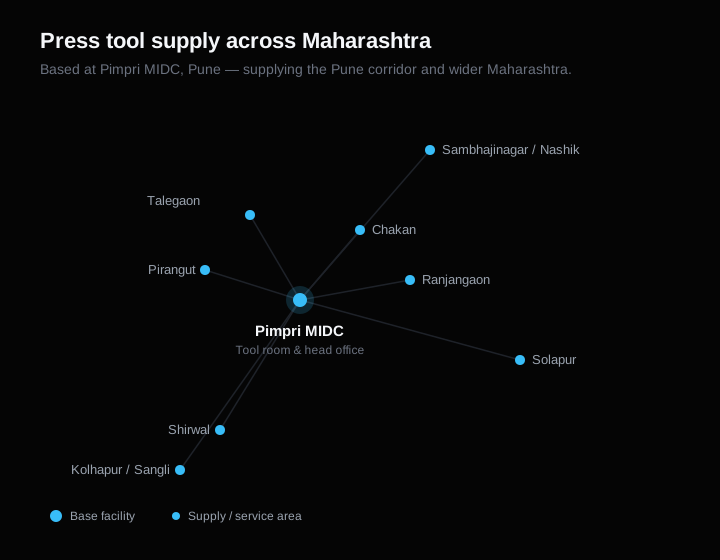
For high-volume tooling, see our press tools manufacturing in Pune.
Terminology, materials, life and lead time.
The terms overlap. A sheet metal die is the specific cutting or forming member; a press tool is the complete tool assembly that mounts in the press. We manufacture both, so one enquiry covers the whole requirement.
Primarily D2 and D3 for dies and M2 HSS for punches, hardened to HRC 58-62. EN31 and other grades where suited. Mill test certificates on request.
From 0.3 mm foil-gauge up to 6 mm plate — MS, SS, CRCA, GI, aluminium, brass and copper.
Yes — simple single-operation dies through to multi-station progressive dies (2–24 stations), based on part complexity and volume.
Typically 2 to 20 lakh strokes depending on steel, clearance, material and lubrication. We also offer resharpening and refurbishment.
We regularly supply and service heavy stamping tools for the automotive and industrial plants located along the Talegaon MIDC highway corridor.
Springback is a significant challenge in sheet metal forming, especially with high-tensile materials. Our engineering team utilizes advanced CAD/CAE software to predict the exact degree of springback based on the material's yield strength and thickness. We then over-bend the forming profiles within the die design to perfectly compensate, ensuring the final component relaxes into the exact desired geometry.
Material utilization is critical for profitability in high-volume stamping. We meticulously design the strip layout to minimize scrap skeletons while maintaining sufficient carrier web strength to transport the part through the progressive stations. We analyze grain direction, nesting options, and pilot hole placement to achieve the highest possible material yield without compromising tool stability.
While our dies are built for extreme durability, regular maintenance is essential. We recommend routine cleaning, lubrication of guide pillars and bushes, and periodic visual inspections for edge wear. When burrs begin to exceed acceptable limits, the punches and die matrices should be professionally re-ground. We offer comprehensive refurbishment and re-sharpening services to restore your dies to original specifications.
Yes. If your product design undergoes a revision (e.g., a hole size changes, a bend angle shifts, or a new feature is added), we can evaluate your existing sheet metal die for modification. Utilizing our wire EDM and CNC machining capabilities, we can often manufacture replacement punches, alter die inserts, or adjust forming blocks, saving you the cost and lead time of building an entirely new tool.
Full tool room capability under one roof in Pimpri.
Share your component drawing and volumes — offer within 48–72 hours.
We review every enquiry and respond with a techno-commercial offer within 48–72 business hours.